April 1, 2026
I've been using Obsidian 🡵 for keeping all of my digital writing and notes all in one place, and it's been a great piece of software. The biggest advantage, in addition to being One Place for all written things, is that it's essentially a system for linking files together—very similar to a website built of hyperlinks. Rather than trying to organize things hierarchically in a sort of top-down approach, I can make and organize notes more fluidly based on their connections to other notes. Organization becomes defined more by Tables of Contents notes that function as mini directories, and finding a note becomes more a matter of clicking through various tables of contents. It also allows for a more bottom-up approach, in that if a note grows too large or unwieldy, I can break sections off into their own files.
I should share more of my Obsidian process, and why I enjoy using it, but for now I thought I'd just share some neat things I found in the process of looking into various methods people have for organizing data and files.
Here is what I found.
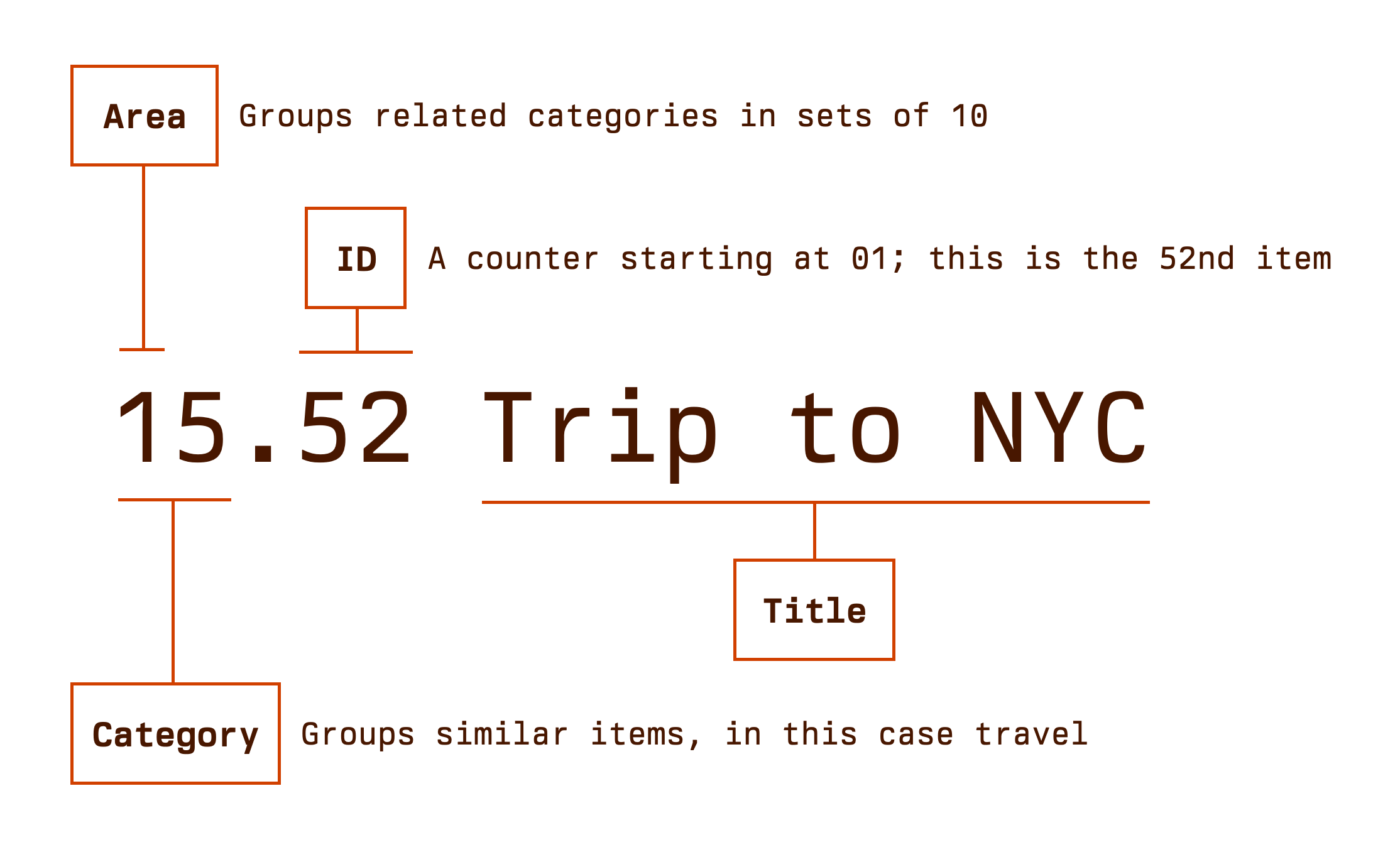
This seems like a neat system for organizing folders. However, despite its grand title, upon closer inspection it seems like it's more just a better method for labeling things using decimal numbers.
For example:
It's the same concept I'm trying to do for my physical notes, but something that would work well digitally as well.
Infinitely adaptable too I think. Start with large folders if needed, then break them out into larger categories as needed.
I take a bottom-up approach, starting with grouping files, then moving up to folders if needed. This is a great way to have a top-down sorting approach as well, using numbers to keep things simple and always in SOME kind of order. The order isn't necessarily that important, but having something to order things that's independent of the actual title of the boxes is great.
In short: this is the next step in my folder process, and something i could apply to obsidian as well. Numbers are a lot easier to keep track of for labeling purposes, and the fact that you add to the number with new categories means it's easy to either sort by importance and by relevancy. The first couple categories are probably going to just be whatever you think of, then you'll have whatever else added numerically, so it'll also represent the order in which you add things.
The shelf concept of 10 items is good, but is also the only think I'm a little iffy on so far, since you do have to limit it to 10 and then also keep things consistent. I could see myself either continually reorganizing things based on the shelf, or spreading topics out over groups of ten arbitrarily just so that I don't "run out of room".
Honestly, this makes me finally want to learn the actual Dewey Decimal System 🡵. I'm not gonna lie, it seems to make more sense than this guy's one, just because it seems more infinitely flexible as a categorization system. There are some gaps, but it's in an order independent of amounts in each category, and more decimal points can be added for more subsections.
Though, the more I look into it, I guess it's actually pretty similar, just scaled to have more numbers.
I guess the main challenge with using it compared to how I've been doing notes so far is that it's a prescriptive method, rather than a grouping based on quantity of items. I do like the concept of numbering though, but not sure how I could apply it to a bottom-up system like I already use.
I've been doing something like this as my bottom up file hierarchy approach:
"Having worked both in libraries and with large data sets I don't think a classification system like Dewey Decimal would work for data sets. For example, if you had a large data set of locations for people on a college campus, that data set could be used for sociological research (who meets up with whom?), or epidemiology (to see who potentially spread a virus), or building maintenance (which buildings have the most people using them?) So what do you classify the data set under? Maybe you could file it under location data (though it is also student+professor+manager data), but what if the basic data is WiFi AP associations? Then the data might also be of interest to wireless network managers and could be classified as wireless management data. So any classification system probably needs a tag system that can apply multiple tags to one data set.
The main point of classification is being able to find what you need, so pigeon holing a data set into one category is not a good idea because data is much more versatile than a single book (although there are problems with Dewey Decimal and books in this regard also). There is also the problem of future categories, catagories that don't even exist now but might retroactively apply to current data sets. So an old data set that might have been tagged with "location" might in the future also need to be tagged with "privacy". Being able to add tags in the future is important.
So a data set is not like a book on a shelf, it's more like a web page, and there should be multiple ways to link to it. Data sets are not physical things, and are not related to a single topic (though they may have been collected for only one purpose initially), so don't use a cataloging system for physical objects to catalog data sets.
That said, the range of data sets is infinite. So understanding your own needs my help limit the number of tags/categories and understanding how your needs may change in the future would help. Machine Learning data sets are often repurposed. Business aims may expand. At the extreme you may want to do some research into the problem of ontologies. Specifically, how to build an ontology of your current and future intentions for these data sets. Look for something flexible because your needs are likely to change, so you may need to transition the "catalog" to a new form in the future. That seems very complicated and difficult, so reduce the problem as much as you can by imposing limits. What is the minimum range of categories that defines your interests?"
The main point being that a dataset is less like a book on a shelf and more like a webpage with multiple ways to link things together. Tags can be good for this, but horrible for keeping track of things since it's easy to wind up with too many tags and variations if you forget. I already forget tumblr tags often enough. Links, however, can be used to build both hierarchy and connections in any direction, where major topical areas are grouped more by multiple general category Table of Contents documents than elaborate tagging systems.
Good tables of contents and collections allow for finding information easily, and the process of grouping folders together eventually creates a hierarchical system of order as well. For example, if three files together are grouped together into a folder by relevance, it doesn't matter where they link to and are linked from, it's more just that they are put in folders. I think it makes sense to use folders sparingly though.
One could argue that if I'm going to do general categories, I might as well do the decimals, but I also might just want to wait until I've established a certain sense of order already with my tables of contents before I try to establish some kind of decimal-based overall hierarchy.
I keep changing things, which is simple and easy to do in Obsidian, but I feel like if I start to introduce some rigidity (i.e. numbering system) then I might get distracted or bogged down. Really cool concepts though.
Seems worth it, but also seems to be one of those things that you know you'll need once you need it, but until you've built a database to reach that level of structure, it can be something that slows you down as you try to fit it into a prescriptive format.
I feel that if I keep linking things together in ways that make sense, and have good table of contents pages for categories, that will ultimately begin to inform the file structure I'll want to use as well. As far as physical paper files go, grouping things based on quantity is probably still the best way for me to build things up, letting my folders and categories be defined by what I need more than trying to prescribe a certain structure upon them. Overall, I think the general move is going to be classifying data by its connections to other data rather than classifying data under categories.
That Hacker News thread also referenced another neat organization method I hadn't heard of before, the Mundaneum 🡵.
Paul Otlet, an early 20th-century archivist, created the universal decimal classification, based on Dewey, for a project similar to what you seem to be after: a collection of information rather than works, in a project called the Mundaneum, in many ways a precursor to Google, though based on index cards. Much of the original was destroyed by Nazi Germany during WWII.I suppose the ideas and challenges of organizing information isn't necessarily a new concept, more just [something I feel like we don't think about as often]. It seems like there's lots of well-established terms for describing various organization methods and practices, I just never seem to hear about them. Something I'll have to learn more about.
The "problem of ontologies" prompted me to look more into what an ontology even is, at least in an information science context. From what I'm understanding, it sounds like a "links-based" approach can also be known as an ontological 🡵 framework, whereas a hierarchical approach can also be known as a taxonomical 🡵 framework.
Seems like this idea of linking data based on relationships is part of a larger field of information science, specifically with applications to development and databases. Seems like some refer to this as The Semantic Web 🡵. They say that ontologies are the backbone of every serious database, which makes sense if a database is all about linking various things together.

A chart comparing different web paradigms. 🡵
The term "relational database" stands out to me as well, I remember that being something I was looking into at least a decade ago after learning about Maltego 🡵 and the concept of graphs with connected nodes.
There's a lot of terms thrown around in this topic, RDF, RDB, RDBMS. Maybe Reddit can illuminate these topics. Found this post:
Ontology in philosophy is the study of being.
Ontology in Computer Science is part of knowledge representation and reasoning. An ontology is a formal (i.e. in some logic) representation of knowledge about some domain that can be reasoned with. You can write ontologies in OWL, Prolog, KIF, or more. OWL has the most accessible tool support with Protege, OOPS!, VOWL, and WIDOCO.
RDF is the most basic of the semantic web namespaces (semantic web is not synonymous with ontology). A namespace is a collection of terms. RDF is a collection of terms to describe resources. So it contains terms to do that like rdf:resource, terms for description (rdf:about) and collections. It doesn't contain sufficient terms to define subsumption and instantiation, which are central to ontology. But it does contain terms that are useful for dealing with triples and it was inline with the goals of the semantic web community, so an new namespace was developed to get closer to those lofty ontology-with-semantic-web goals: rdfs.
RDFS is the Resource Description Framework Schema, it's another vocabulary namespace. It gives us the terms to define classes (rdfs:Class), subclasses (rdfs:subClassOf), and instances (rdf:type). Now we can define things recognisable as ontologies using semantic web technologies. But the researchers weren't done yet. An effort to make use of what was being learnt in the description logics and frames communities was undertaken to develop a more expressive and computable vocabulary, which is OWL.
OWL is the Web Ontology Language, it's yet another vocabulary namespace. It's more expressive with far more terms, but rather than redefine what came before with RDF and RDFS, it just re-uses those appropriate terms. With OWL you can choose different variants with trade-offs between expression and computation speed. OWL is probably the most popular of the ontology languages, but it's not the most expressive. The few grey-hairs I know who've worked with ontologies outside of the ivory towers typically only use semantic web languages for data-transfer, but use logic programming languages for the reasoning, that may be because I spend a fair bit of time in logic programming circles though.
So an ontology is a particular way of defining some representation of some knowledge. This typically means classes and instances, subsumption, and predicates that can have properties such as being transitive or symmetric. RDF, RDFS and OWL are namespaces that contain terms that can be used to author an ontology. Additional tools exist to reason with ontologies written using the terms defined in these namespaces, so an ontology written in OWL can be queried with SPARQL via a tool, or reasoned over with Pellet, Hermit, or Prolog. But an ontology could also be written just in Prolog.
Very interesting. I think the hardest part with learning about bigger picture things is that it's easy to find small topics that belong to a larger category, but it can be harder to find the even larger category that the first larger category belongs to. There's so many interesting theories and areas of thought that are otherwise mysterious and impenetrable to me without knowing the words and terms to search for, so it can sometimes feel like stumbling in the dark.